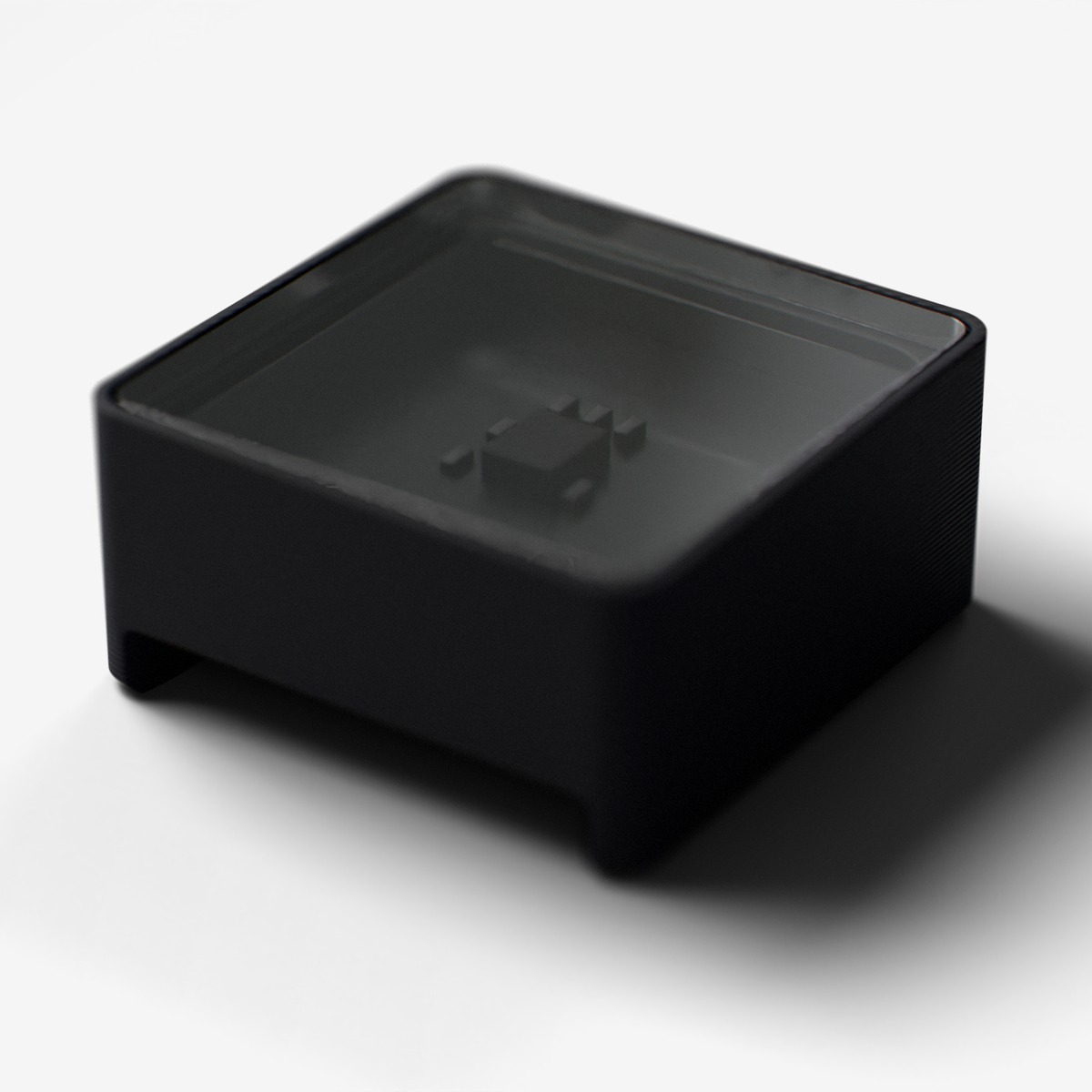
Orientation Sensor
Inertial measurement unit that detects rotation and movement
An inertial measurement unit that detects rotation and movement in all directions. It picks up tilting, spinning and acceleration, for game controllers, gestures or logging motion.
For ages 14 and up. Not a toy. Contains small parts: choking hazard. Keep away from children under 3. Adult supervision recommended.
Made by Atech ApS, Lille Strandstræde 6A, st. th., 1254 København K, Denmark.
Technical specifications
- Part
- 6-Axis IMU (ICM-40608 or LSM6DSOX)
- Interface
- I2C (0x68)
- Ports
- 1 port
- Current
- ~4 mA
- Size
- 19.5 x 19.5 x 9.5 mm
- Chip
- LSM6DSOX (STMicroelectronics)
Pins
- 3.3V
- supply
- GND
- ground
- Data A
- I²C SDA
- Data B
- I²C SCL
Key features
- 3-axis accelerometer
- 3-axis gyroscope
- Detects tilt, rotation, and acceleration
- Instant motion readings
Common applications
Technical
Orientation Sensor
6-Axis IMU (ICM-40608 or LSM6DSOX)
6-axis inertial measurement unit with 3-axis accelerometer (±2g), 3-axis gyroscope (±250°/s), and on-die temperature. The driver auto-detects which chip is attached at boot (ICM-40608 at 0x68 or LSM6DSOX at 0x6A), so generated user code is identical either way. Background RTOS task polls at 100Hz, readings are instant.
read_accel_xRead X-axis acceleration in gfloat gread_accel_yRead Y-axis acceleration in gfloat gread_accel_zRead Z-axis acceleration in gfloat gread_gyro_xRead X-axis rotation rate in degrees/secondfloat deg/sread_gyro_yRead Y-axis rotation rate in degrees/secondfloat deg/sread_gyro_zRead Z-axis rotation rate in degrees/secondfloat deg/sread_temperatureRead sensor die temperaturefloat Cget_pitchPitch angle (nose up/down) in degrees, -90..+90, from accelerometerfloat degget_rollRoll angle (left/right tilt) in degrees, -180..+180, from accelerometerfloat degget_tilt_angleTotal tilt from upright in degrees (0 = flat face-up, 180 = flat face-down)float degget_orientationCoarse 6-way orientation: face_up, face_down, edge_right, edge_left, edge_front, edge_back, unknownstringwas_shakenEdge-triggered shake/tap detector (returns true once per spike >1.8g, then resets)bool
6-AXIS IMU (ORIENTATION SENSOR):
- Background RTOS task polls the chip at 100Hz. All getters return cached
  values instantly, never blocking, safe to call every loop iteration.
- PREFER DERIVED HELPERS over raw axes. Users almost always want "tilt",
  "shake", or "which way is up", not three raw float streams. Reach for
  raw axes only when the user explicitly asks for gyro/accel values, a
  custom fusion algorithm, or scientific logging.

DERIVED API (use these first):
- getPitch()  -> degrees, -90..+90 (nose up positive). Accel-based, so it's
                 accurate when the board is roughly still but noisy under
                 acceleration. Good for tilt-to-control UIs.
- getRoll()   -> degrees, -180..+180 (left/right). Same caveat as pitch.
- getTiltAngle() -> degrees from upright. 0 = flat face-up, 90 = on its
                    side, 180 = flat face-down. Best single value for
                    "is the board tilted" questions.
- getOrientation() -> ICM40608::Orientation enum (ORI_FACE_UP, ORI_FACE_DOWN,
                      ORI_EDGE_RIGHT, ORI_EDGE_LEFT, ORI_EDGE_FRONT,
                      ORI_EDGE_BACK, ORI_UNKNOWN). Switches when one axis
                      clearly dominates (>0.7g), with natural hysteresis
                      between faces.
- getOrientationName() -> const char* "face_up" / "face_down" / "edge_*" /
                          "unknown". Convenient for printing/events.
- wasShaken() -> true ONCE per shake/tap (>1.8g spike). Edge-triggered:
                 reading it clears the flag. Poll it once per loop:
                   if (imu.wasShaken()) { trigger_thing(); }
                 For a "real shake gesture" (vs. a single tap), require
                 2-3 wasShaken() events within ~500ms before reacting.
- setShakeThreshold(g) -> tune sensitivity. Default 1.8g. Drop to ~1.4 for
                          light taps, raise to ~2.5 for vigorous shakes.

RAW API (only when needed):
- readAccelX/Y/Z()  -> float g, ±2g full-scale.
- readGyroX/Y/Z()   -> float deg/s, ±250°/s full-scale.
- At rest with the module flat face-up, readAccelZ() ≈ +1.0 and X/Y ≈ 0.
- Gyro has small zero-offset bias. If you read raw gyro, call
  calibrateGyro() ONCE in setup() with the board stationary. It averages
  100 samples and subtracts the bias from every subsequent read.

PATTERNS:
- Tilt → output mapping (LEDs, screens, motors): scale pitch/roll directly.
  Example: int hue = (int)((getRoll() + 180.0f) * 255.0f / 360.0f);
- Detect "face down" gesture: if (imu.getOrientationName() == "face_down").
  To avoid flapping, require it to stay there for ~200ms (track last
  orientation + a millis() timestamp).
- Shake-to-trigger: just `if (imu.wasShaken()) { ... }`. Don't try to roll
  your own threshold from raw accel; the driver already does it.
- "Is the board moving?": use total gyro magnitude:
    float w = sqrtf(gx*gx + gy*gy + gz*gz);  // deg/s
    bool moving = w > 30.0f;

AXES & ORIENTATION:
- The IMU's axes are the chip's axes, in the module's PCB frame: +Y points
  outward from the connector toward the module's free end, +X is one
  quarter-turn clockwise of +Y seen from above, +Z up out of the face.
  setMountRotation(deg) turns X-Y into the board frame (+X right edge, +Y
  top edge); the server's setup_order gives the degrees for the port
  (p2p/phases/firmware.py MOUNT_ROTATION_BY_EDGE). pitch/roll/orientation
  assume the board lies flat; mounted vertically, their meaning rotates
with it. Tell the user this if their layout depends on orientation.Three live linear gauges (X / Y / Z) for accelerometer or gyro values that update from incoming sensor events. Add a small 3D orientation indicator (rotating cube or plane) that reflects the live pose, and a 60-second sparkline per axis below.
| Pin | Line | Dir | Function |
|---|---|---|---|
| 1 | HV | – | not connected |
| 2 | 5V | – | not connected |
| 3 | 3.3V | input | supply |
| 4 | GND | – | ground |
| 5 | Data A | bidirectional | I²C SDA |
| 6 | Data B | input | I²C SCL |
from p2p/ground_truth/hardware/prototyping_line/modules/orientation_sensor.md