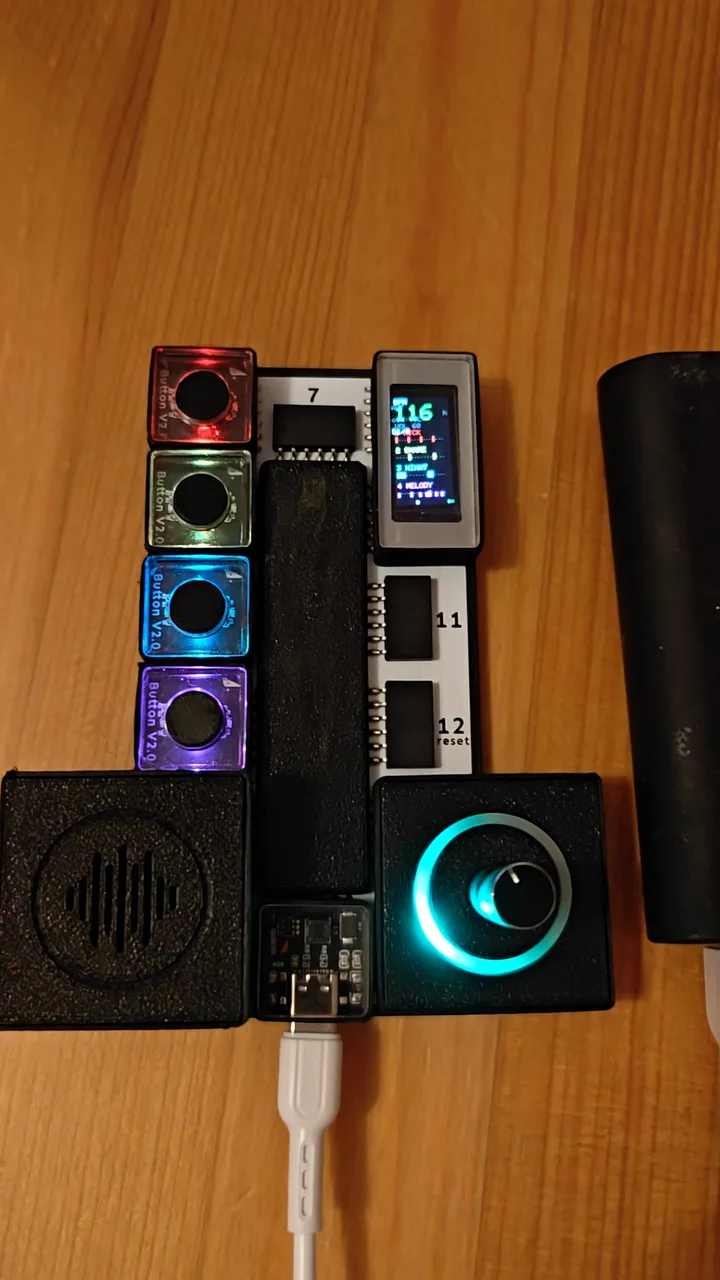
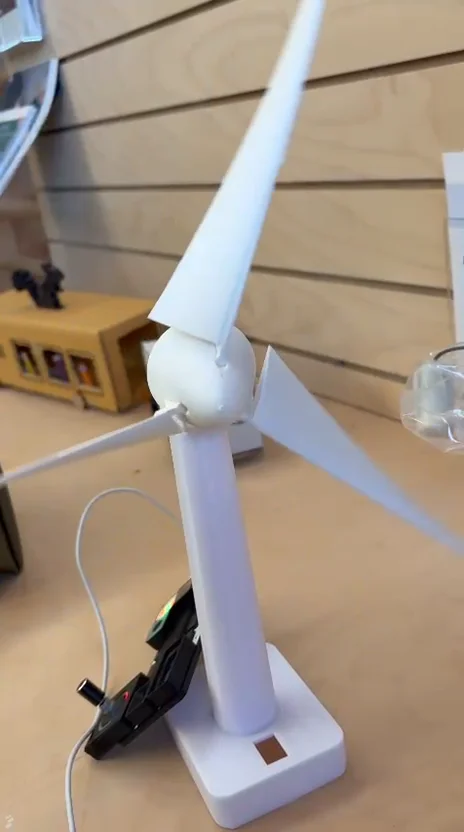
Smart dog bowl scale
A lit bowl that knows how much dinner is left.
These parts on their own: $96.
- 14-Port Motherboard×1
- USB-C×1
- Light Grid×5
- Speaker×1
- Load CellComing soon×1
Smart Home · Wi-Fi · Bluetooth
What it does
The bowl stands on a load cell. It weighs the food and knows how much dinner is left.
Five light grids around the rim light up with how full it is.
How to build it
- 1Wire the load cell amplifier to port 10: ground, 3.3 V, data on line A, clock on line B.
- 2Plug the cable into port 1 and lay the light grid flat at the front.
- 3Slide the light grid into port 2.
- 4Slide the light grid into port 5.
- 5Slide the light grid into port 9.
- 6Slide the light grid into port 13.
- 7Slide the speaker into ports 3 and 4.
- 8Slide the USB-C into port 8 and plug the cable into your computer.
- 9Plug it in and press Upload to board.
Uploading works from Chrome or Edge on a computer. Open this page there with the board plugged in.
On the board
- 10Load CellWeighs the bowl
- 1Light GridThe front light, on a cable, lying flat in the floor
- 2Light GridUnder the platter
- 5Light GridUnder the platter
- 9Light GridUnder the platter
- 13Light GridUnder the platter
- 3+4Speaker"Need water" when the bowl runs empty
- 8USB-CPower and programming
The code
lapper.cpp · 570 linesDownload
// Lapper v2: weighing dog-bowl stand. Atech 14-port board (ESP32-S3), HX711 on port 10,
// Electrokit 5 kg bar cell, up to FIVE Atech LED grids (NeoPixel 3x3, 9 px each) lighting the
// clear-PETG platter from inside: four plugged straight onto the board's sockets facing up
// (ports 3-6) and one on the 80 mm cable lying flat in the floor at the front (port 2).
//
// What it does
//   - Weighs the bowl continuously (10 Hz), same HX711 chain + filters as the Atech scale firmware.
//   - Learns the EMPTY BOWL weight itself: the lowest stable weight it has ever seen above the
//     bare-platter zero is the bowl. (Bare platter = TARE, done once at assembly.)
//   - Water grams = total - bowl. Full / low / empty thresholds in grams (1 g = 1 ml).
//   - Drinking sessions: a stable-to-stable drop while a dog is at the bowl (weight noisy, then
//     lower) is logged as one drink in ml. Splashes and paws (weight UP then back) are ignored.
//   - 2.2: the LIGHT IS THE PLATTER. The whole platter and the bowl on it glow: soft warm white
//     when fine (AMBIENT <pct>), 1.5x brighter while a dog drinks, faint blue when the bowl is
//     lifted, amber breathing when low, red pulse when empty. GLOW 0 is the master switch.
//     NIGHT <on_h> <off_h> turns the ambient glow off between those hours (alerts still show);
//     there is no RTC, so the app sends TIME <hh:mm> at connect and the firmware counts from there.
//     Power cap: 45 pixels x 3 channels x 20 mA = 2.7 A at full white, the board's 5 V rail is
//     the grids run on the 3.3 V rail (500 mA), so every grid runs under setBrightness(BRIGHT_CAP = 45) -> 17.6 %, <= 0.48 A worst case.
//   - 2.1: per-dog intake. DOG <kg> once; every drink and the 2 Hz line then carry ml/kg for the
//     day. At the 24 h rollover a "day" event sums the day, flags polydipsia (> 100 ml/kg/day) or
//     near-zero intake (< 20 ml/kg/day) and compares it with a 7-day ring kept in NVS (HISTORY).
//     Thresholds and the ml/kg framing come from docs/RESEARCH.md [S14], [S15].
//
…